
Earning Money with Volatility Through Grid Trading Strategies
Many beginners are comfortable when price moves within a trend. If the market is trending upwards, go with the flow and buy during pullbacks. It’s easy and straightforward.
But when trends die off and the market starts moving within a consolidation range many feel lost and start burning capital.
But experienced traders already know that when markets move sideways, you can spot grid levels that can be used for positioning entry and exit points. What makes it even better is that you can easily automate the process so orders are placed and replaced without having to monitor the market full-time. This is what grid trading is about.
Grid Trading Explained for Beginners
A sideways market is usually defined by a support level and resistance level that keep prices within a specific price range. When the stock reaches a certain point, buyers step in to push it upwards, and the opposite happens when it gets to a certain level and sellers push it downwards.
With grid trading, you split this consolidation range into price levels and assign orders to them. Buy orders are placed below the current level. Sell orders are placed above.
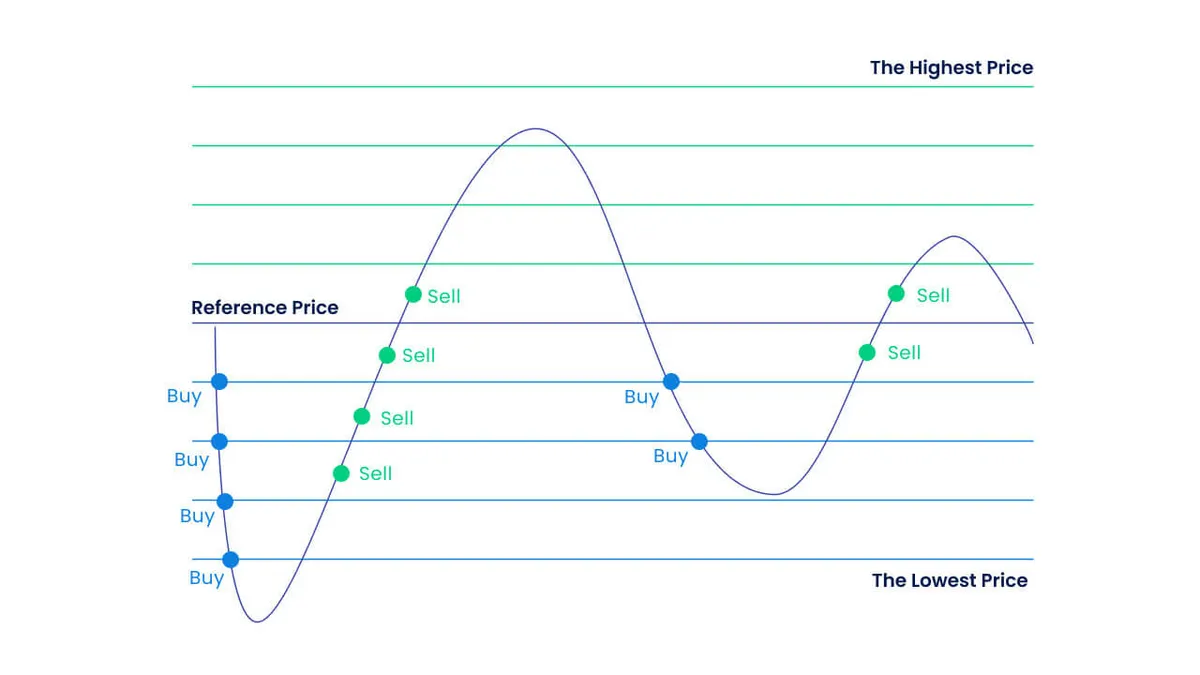
Imagine Bitcoin trading at around $85,000. Set up a lower boundary and an upper boundary, and use the levels in between to place orders.
| Price | Order |
| $88,000 | Sell order |
| $87,000 | Sell order |
| $86,000 | Sell order |
| $85,000 | Current Price |
| $84,000 | Buy order |
| $83,000 | Buy order |
| $82,000 | Buy order |
While the consolidation is valid, you’re buying low and selling high through repeated fluctuations.
How Grid Trading Works: Grid Parameters and Mechanics
Building a grid trading strategy starts by defining its parameters. Let’s go through them:
1. Setting the Price Range
Identify the current price and set the upper and lower boundaries. Note that you don’t necessarily have to use the market’s support and resistance levels, you can build your own range inside the market’s range. Volatility indicators, like the ATR, help you define the distance of your boundaries in a way that is more aligned with the current market context.
2. Setting Grid Levels
There are two different methods of creating a grid. Arithmetic grid divides the price range by equal dollar amounts. A geometric grid uses equal percentage spacing. You have to consider that a higher number of grid levels creates smaller gaps between the orders which increases the frequency of trades, also increasing fees, and execution costs.
3. Placing Buy and Sell Orders
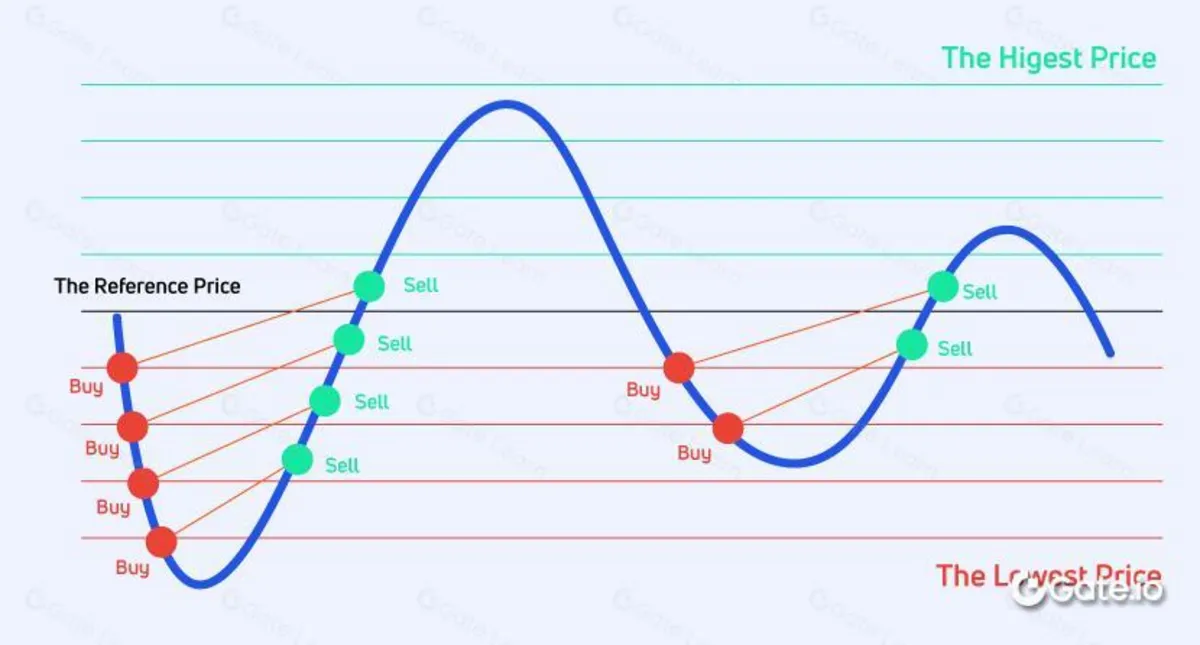
Here you’ll be focused on placing buy and sell orders at predefined price levels. Each filled buy must create a corresponding sell order one level higher, as illustrated below.
4. Setting Risk Controls
Risk management is especially important when setting up your grid bot. It must be fully aware of trigger price, stop-loss and take-profit. Depending on the platform you’re using you will also want to set up an automatic way to close the grid strategy once price breaks out of the range.
5. Backtesting
Backtesting is important to understand how the strategy would’ve reacted to historical moves. Many demo accounts let you backtest your execution without putting any money on the line. Backtesting is important to refine the strategy and ditch things that clearly don’t work out.
How to Set Up a Grid Trading Bot
Setting a trading bot comes after setting a grid trading strategy. And a well-thought strategy depends on a few additional things.
So first and foremost, you must watch for trend strength and volatility. The ADX indicator is a good ally in highlighting low values that support a range-based strategy such as grid trading. Volatility will help you define the distance of your boundaries and stop losses, as previously explained.
Liquidity is also important as a liquid stock, crypto, forex pair, index, or commodity generally offers more order execution, even within a range.
Another important aspect to consider is capital. When trading grid levels you’re essentially dividing available capital across multiple positions so you got to be aware of exposure if several buy orders are filled before any rebound happens. And you also got to account for execution costs and fees.
Once you have backtested your parameters, you automate all of the rules through algorithmic trading strategies and trading bots. But automation only comes after the strategy is already mature and proven.
Why Using a Grid Strategy Can be Dangerous in Trending Markets
We talked a lot about the good aspects of grid trading strategies, but we also have to mention the caveats.
The biggest challenge that can come towards a grid strategy is when the price breaks out of the expected range and keeps moving in one single direction.
When that happens, you can be positioned after accumulating many buy orders without ever hitting sell levels. Naturally, your losses will also accumulate.
So in general, your focus is on using grid trading strategies when prices are moving within a range and as soon as that pattern is broken, your focus should shift towards trend following strategies or whatever is more suitable according to market conditions.
Types of Grid Trading Strategies
| Grid Type | Main Feature | Typical Use |
| Static Grid | Fixed price levels | Traditional range trading |
| Dynamic Grid | Grid levels adjust alongside the price | When market conditions are less stable |
| Proportional Grid | Percentage-based gaps | Mostly used with assets that have large price changes |
| Expanding Grid | Wider spacing farther from the initial level | For stocks that have larger price movements |
| Constrained Grid | Tight ranges | Consolidations within lower volatilities |
| Multi-level Grid | Used when settings differ within layers | Usually used for more flexible exposure |
| Bi-directional Grid | Target both long and short positions | Two-way market fluctuations |
The Pros and Cons, Martingale, DCA, and Trend Trading
So, one of the main strengths behind grid trading is that it can generate frequent realized profits when price keeps fluctuating through the configured levels repeatedly, which also favors automation and reduces the burden of manual order management.
However, that also increases the downside exposure when sudden breaks happen.
Let’s talk about some other mechanics/strategies that get often confused with grid trading.
Martingale
Martingale and grid trading can sometimes look similar because both can accumulate exposure during adverse moves. But the main difference is that Martingale is based on changing position size after losing trades, even doubling the next position. This is an extremely risky approach where you increase your position size after each loss. Definitely not recommended for beginners.
DCA
DCA is also known as dollar-cost averaging. It can sometimes be compared to grid trading because it’s an investment strategy where you invest a fixed dollar amount at a predetermined interval, regardless of the current price. So you are essentially dividing capital into smaller increments and can sometimes also accumulate losses. However, DCA is a long-term investment strategy, focused on wealth-building while removing the need to time the market – which makes it much different compared to grid trading
Trend Trading
Trend trading is the complete opposite of grid trading. While grid trading assumes that prices will repeatedly reverse, trend trading assumes momentum will persist upwards or downwards. The major takeaway here is that, when conditions change to a point where grid trading might not be applicable anymore, trend trading has the potential of taking its place.
Frequently Asked Questions
Is grid trading illegal?
No. Grid trading is a trading method that might or might not use automation tools. Many platforms actually provide grid-bot functionalities for their customers.
The rule of thumb is following local regulations, exchange rules, and any requirements for automated trading. So before using a trading grid, confirm that the exchange and/or broker permit automated positions within their platforms and systems.
What markets are best for grid trading?
In general, liquid markets that move sideways within well-defined support and resistance levels.
Forex trading, cryptocurrency, stocks, indices. Every volatile market is a candidate for grid trading strategies.
How much money do you need to start?
The capital needed to start depends on the asset, grid size, number of levels, plus the additional costs and fees.
I have to say, grid trading tends to require a larger amount of capital to be executed properly and “comfortably”. You must at least have enough capital to maintain multiple open positions.
For beginners who don’t have much capital, you can try using smaller grids while testing the strategy and building your trading balance. Increase position size only after reviewing and iterating your strategy
How can a beginner build and put a grid trading bot into production?
Beginners should focus on building a working strategy first. Once they have that, they can start by defining the bot’s rules before writing any code (i.e., define the asset, set the upper and lower price boundaries, select the type of grid spacing, calculate the order size for each level, define stop-loss and take-profits, maximum exposure limits, etc.). The bot should also be aware of fees, spread, slippage, etc.
Test the bot with historical data to confirm it places orders correctly, handles partial fills, reconnects after internet/exchange outage, etc. Keep API keys restricted to actions that are only necessary for execution and store credentials securely. Use different environments for production and testing/development.
More importantly, when the bot is finally in production, deploy it with a small amount of capital. Monitor its logs and set alerts for anything that might require your immediate attention, like large drawdowns, failed orders, connection problems, etc.